Exercise is good for you. But what's the right amount?
You probably already know that aerobic exercise like running, biking, or swimming is good for you. You may even have read advice online about the right amount. But what does science say on the subject? Should you aim for 10,000 steps or 75 minutes? Should you do high-intensity interval training (HIIT) or swimming? Daily, or are weekends enough?
By now, there's a huge volume of research on the topic, and thanks to my new auto-research engine, I can write a post that explores much of it. By my count, it has now downloaded and analyzed roughly 200 papers on the subject, and I've put together the main findings in this post.
The headline numbers
If you're looking for a short answer, this recent review of 196 studies across 94 datasets has it: to get the most benefits, aim for around 150 minutes a week of "moderate" activity like brisk walking or easy biking, or 75 minutes of "vigorous" activity like jogging.
Past that point, the benefits quickly plateau: an umbrella review for the US guidelines committee found that reaching 150 min/week of moderate exercise gets you "about 75 percent of the maximal benefit." Beyond that, "more physical activity is required to obtain less benefit," with those doing roughly 7.5 hours/week of moderate or roughly 3.5 hours/week of vigorous exercise seeing no further health improvements.
But really, any amount is better than none, and most gains come from the first minutes. For example, in this study of Taiwanese adults, people doing about 15 minutes a day of moderate exercise had a 14% lower risk of death from any cause (so-called "all-cause mortality") and roughly three additional years of life expectancy compared with inactive people. The next 15 minutes a day was associated with only additional 4% reduction in mortality.
Intensity matters more than the exercise type
Minutes, however, are not a great unit of measurement because they are not interchangeable. Reviewing the device-measured evidence, researchers estimated that light activity needs roughly three to four times the duration of moderate activity to produce the same reduction in risk.
Push into genuinely hard effort — the kind where you can't hold a conversation — and the exchange rate flips: among 71,893 adults wearing wrist accelerometers, as little as 15 minutes a week of intense activity was associated with about 18% lower mortality, with the curve (shown on the chart below) bottoming out near 54 minutes a week at 36% reduction in mortality. That's less than an hour per week!
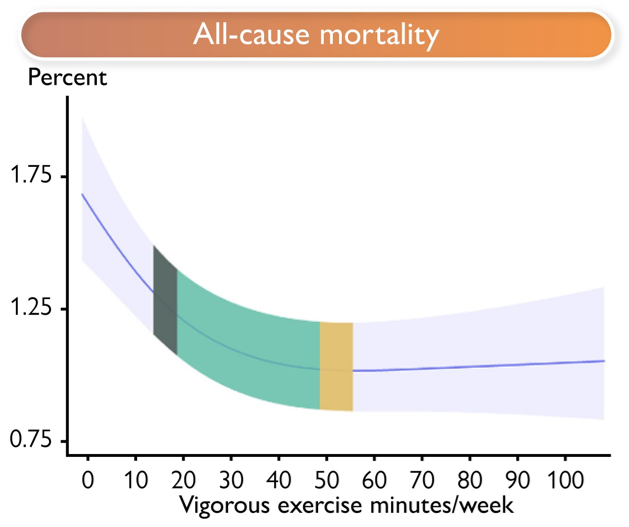
With intensive exercise, adjusted risk of death from any cause ("all-cause mortality") sharply drops at first, and then bottoms out after around 50-55 minutes. Source: Matthew N Ahmadi et al, "Vigorous physical activity, incident heart disease, and cancer: how little is enough?", https://doi.org/10.1093/eurheartj/ehac572.
And those intense minutes need not come from deliberate exercise. Another study followed 25,241 people who reported no leisure-time exercise and measured the brief bursts of hard effort embedded in daily life: hurrying for a bus or carrying shopping upstairs. Just 4.4 minutes a day of these one-to-two minute bursts was associated with 26–30% lower overall mortality and a 32–34% lower cardiovascular death rate. A follow-up analysis added an important qualification: bouts of one to ten minutes were associated with 34–52% lower mortality than bouts under a minute, unless those very short bouts contained truly vigorous effort. In other words, incidental exertion appears to count, provided the bursts are long enough or genuinely intense.
HIIT (high-intensity interval training) fits this pattern too: it helps you get more high-intensity minutes, but aside from that it's just another form of exercise. On various fitness markers, HIIT sometimes does a bit better than steady endurance training and sometimes a bit worse, but in either case, some exercise is much better than none.
Spread out evenly or once a week?
As it turns out, it doesn't matter. Pooling 63,591 adults across 11 UK cohorts, researchers found that people who did all their exercise in one or two sessions a week had 30% lower overall mortality and 40% lower cardiovascular mortality; these figures were statistically indistinguishable from those of people who spread it across three or more sessions. Accelerometer studies in two large cohorts have since reached the same conclusion.
A study of older women made the underlying point most sharply: once you adjust for total weekly steps, the pattern of how those steps were distributed stopped predicting anything at all. So ultimately, it's the volume that matters, not the timing.
What actually matters, however, is consistency over the years and decades. Across 85 prospective studies covering roughly 6.6 million individuals, people who stayed active or became more active across adulthood had 20–40% lower overall mortality and 30–40% lower cardiovascular mortality.
So what do you get from exercise?
So far, I've mostly cited all-cause mortality, i.e. the risk of dying from any cause in a given year. But the benefits are much wider than that:
- Cancer: Higher activity was linked to a 10–20% lower risk of bladder, breast, colon, endometrial, oesophageal, gastric, and kidney cancers. After diagnosis, it was associated with 37% lower all-cause and 18% lower cancer-specific mortality.
- Cardiovascular health: Endurance training lowered resting blood pressure modestly overall but substantially in people with hypertension, by about 8 mm Hg systolic blood pressure.
- Immunity. Regular activity was associated with 31% lower risk of community-acquired infectious disease and 37% lower infectious-disease mortality, and about 31% lower pneumonia risk. Among 577,909 US adults, even 10–149 minutes a week tracked with 21% lower influenza and pneumonia mortality.
- Thinking and memory. Pooling 2,724 randomized trials, exercise improved general cognition with a standardized effect of 0.42. Restricted to the highest-quality reviews, the effect shrank to 0.23: real and modest, but not transformative.
- Body composition. In 116 trials, each additional 30 minutes a week of aerobic training cut weight by about half a kilogram; at 150 minutes a week, the average was 2.8 kg lost and 4.2 cm off the waist — clinically meaningful, though less impactful than diet.
Where the evidence is less certain:
- Depression. A meta-analysis of 218 trials found walking or jogging produced effects comparable to psychotherapy and roughly twice those of SSRI antidepressants. However, the authors of the review rate confidence in the results as low, as almost every trial carried a high risk of bias.
- Sleep. Exercise reliably improves how people rate their sleep (22 trials show a clinically meaningful gain in subjective quality) but objectively measured sleep metrics barely moved, and an earlier analysis reached the same conclusions while rating the evidence low to very low quality. The clearest benefit was in obstructive sleep apnea, where training cut breathing interruptions by six events an hour largely independent of weight loss across 129 people.
You can overdo it, but the threshold is roughly "competitive endurance athlete"
There are definitely risks to over-exercising. Of these, atrial fibrillation — an irregular, rapid heart rhythm — is the clearest. Among master endurance athletes aged 40 and over, 32% had atrial fibrillation versus none of the non-athletic controls, and the risk persisted in athletes who had already retired from competition, as atrial remodelling did not reverse. That said, in two Swedish general-population cohorts followed for up to 27 years, high physical activity showed no statistically significant association with atrial fibrillation once cardiovascular risk factors were accounted for. So this appears to be a competitive-athlete phenomenon, not a jogger phenomenon.
Coronary artery calcium is likely less of a problem than it appeared at first glance. High-volume exercisers do accumulate more calcified plaque (nine of twelve studies above 450 minutes a week found higher scores) but the same review found lower mortality and cardiovascular event rates in those groups anyway, which rather undercuts the alarm. The heterogeneity across those studies was extreme, so treat it as unsettled question rather than settled one.
The more mundane risks are regular exercise injuries: knee pain, shin splints, plantar fasciitis, and others. They are especially common in new runners, who sustained 17.8 injuries per 1,000 hours of running versus 7.7 for experienced recreational runners.
So what's the right amount of exercise?
Getting back to the original "what's the right amount" qusetion, the practical answer is: if you can, build toward 150 minutes a week of something that raises your heart rate, or half that if you prefer genuinely hard effort. It does not need to happen every day, in a gym, or in an activity you hate. Walking fast, cycling, swimming, playing a sport, taking the stairs with purpose: the body is not especially concerned with the type of the exercise, only the total amount and intensity.
But really, any amount is better than none. So if you're struggling to commit to 75 minutes of jogging a week, start with a five-minute jog twice a week and see if you can work your way up. Or don't; you'll still see some benefits.
And overall, it's more important to stick with an amount you can do consistently week to week over the years. The right amount of exercise is, in the end, the amount you will still be doing ten years from now.